


07.04.2026
Author: Damian Schärli
Purchasing decisions in supermarkets are often made in a matter of seconds. Customers stand in front of the shelf, compare products and make their choice. It is precisely at this moment that in-store retail media comes into its own: messages appear exactly where they can have an immediate impact.
Digital signage at the point of sale offers significant added value in this regard. In practice, however, it quickly becomes clear that the real challenge does not lie in the hardware, but in its operation. Impact is only achieved when content is delivered reliably, is up to date and is locally relevant.
Why in-store screens on the shelves are effective.
A display stand near the shelves has a direct impact on the purchasing decision. For a message to be effective in this environment, it must be tailored to the store, the product range and the current promotion.
This is precisely what makes in-store screens so attractive for retail media. At the same time, however, this increases the complexity. A premium location alone is not enough. Without the right content, the potential remains untapped.
Premium hardware, high content management costs.
In many setups, hardware, form factor and rollout are now easily manageable. The challenge begins with content delivery.
Typical practical hurdles:
- Manual adjustments for each branch and product range
- Lengthy cycles involving brand assets and approvals
- High operational overhead in day-to-day business
Without the right content, digital signage at the POS cannot demonstrate its full potential. If every campaign is managed operationally as a standalone project, the offering remains usable on an ad hoc basis but is not scalable.
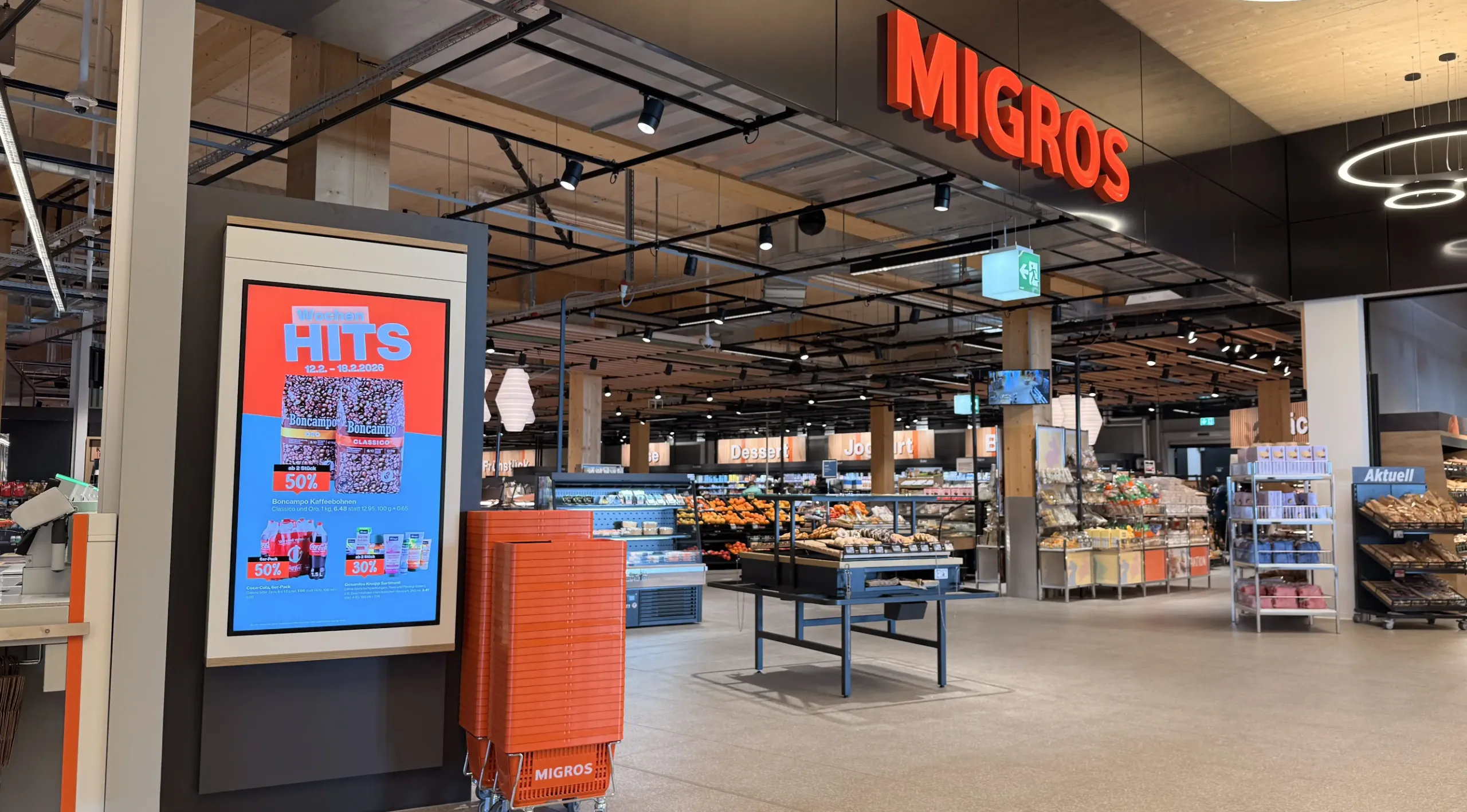
Case study: Scalable shelf displays in supermarkets.
In the Migros context, the vision was clear: shelf displays were to be rolled out in a standardised manner across supermarkets and function as a meaningful channel.
This requires three things:
- Roll-out capability: Efficient installation and operation in stores
- Local relevance: Content tailored to the store, product range and promotions
- Product logic rather than project logic: An offering that is commercialisable and operable
It is precisely at this point that a screen becomes a functioning media product.
Content automation instead of manual creation.
In such setups, the solution usually no longer lies in manual creation and distribution, but in a system that automatically processes and delivers content.
In practice, this means:
- Interfaces to relevant retail systems
- Automated content creation
- Standardised templates across multiple screen formats
This transforms individual screens into a scalable channel. Content remains brand-compliant whilst being delivered dynamically and with local relevance.
Digital signage setup at the POS: inventory and rules.
A successful in-store retail media setup does not start with the ad itself, but with inventory management and clear operating rules.
Key fundamentals include:
- What screen locations are available?
- What content is permitted to run where?
- What are the priorities for national and local content?
- Which data sources control availability, promotions and daily highlights?
- Which templates are approved for which formats?
This groundwork significantly reduces the effort required later on and lays the foundation for a scalable rollout.
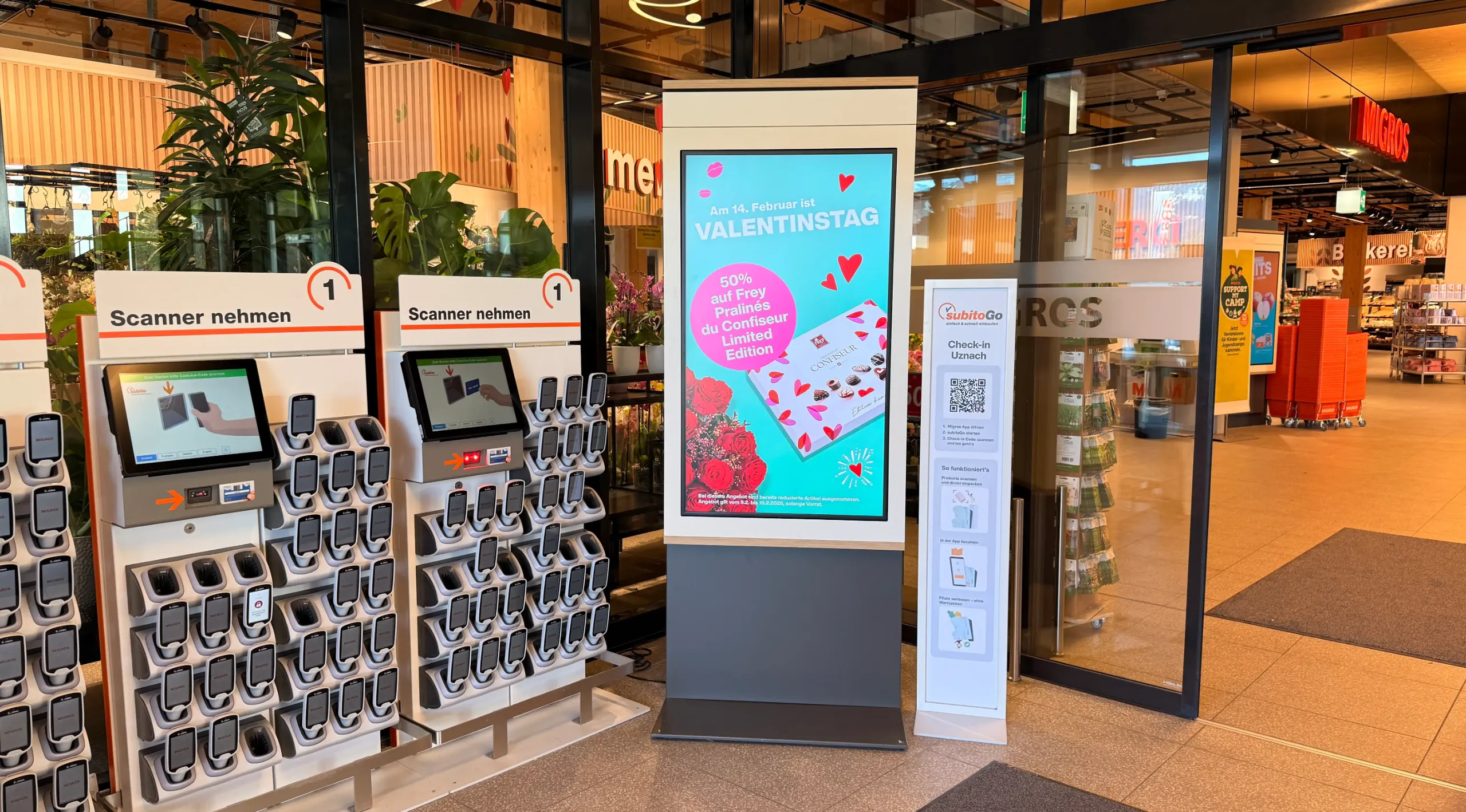
Scaling digital signage operations: processes and monitoring.
Whether a setup really works is not revealed during the pilot phase, but in day-to-day operations. What matters most are clear processes, smooth operations and a system that runs reliably across multiple branches.
The following have proven effective in practice:
- Standardised installation and deployment processes
- Clear lines of responsibility between the retail media team, shopfitting and IT
- Modular templates instead of individual designs
- A user-friendly CMS for national and local content delivery
- Monitoring as an integral part of operations
This is how digital signage evolves from a one-off project into a manageable component of POS communication.
Local content at the point of sale increases relevance.
Content has a particularly strong impact on the shelf when it is tailored to the specific shopping situation. Locally relevant content is therefore not simply additional advertising, but often provides concrete guidance during the purchasing process.
For example:
- Current promotion in this branch
- Suitable bundle
- Alternative if out of stock
- New addition to the local range
- Daily highlight with a direct link to the purchase
This makes communication more helpful, context-relevant and closer to personal needs. Automation is therefore not just a matter of efficiency, but above all a matter of relevance.
Measurability at the POS starts with operations.
Measurability does not begin with campaign evaluation, but with the actual operation.
First, it must be clear:
- Was the content displayed correctly?
- Was it shown at the right location and during the right time period?
- Were local rules adhered to?
- Is the inventory technically available?
- How quickly can content be gone live?
This operational measurability forms the basis for any further evaluation. Only on this basis can campaign performance and optimisations be properly assessed.
Key takeaways for in-store retail media using digital signage.
The following tasks are essential for a scalable in-store retail media project using digital signage:
- Define the inventory and rules first
- Use templates rather than individual graphics
- Consistently consider interfaces
- Treat local relevance as a must
- Plan operations and monitoring as part of the product
This is how a good space is transformed into an effective channel.
Interested in discussing «Digital Signage»?
Contact Damian:

In-store retail media using digital signage
What is in-store retail media?
In-store retail media refers to digital or physical advertising spaces in brick-and-mortar retail that are used directly within the shop environment. These include screens, shelf displays and areas in the entrance hall. The advantage lies in the proximity to the moment of purchase.
Why is digital signage particularly relevant for in-store retail media?
Digital signage enables flexible and timely content delivery at the point of sale. Messages can be tailored to the specific branch, product range, promotion or time period. This increases relevance compared to static advertising materials.
What is the biggest bottleneck when it comes to in-store screens in supermarkets?
In many cases, it is not the hardware that is the bottleneck, but the process of uploading content during operations. If content has to be adapted manually for each branch, the workload increases significantly and scaling becomes difficult.
Why is locally relevant content at the POS so important?
Purchasing decisions are made within a specific context. Content that is tailored to the branch, the product range and the current situation is more helpful and appears more closely aligned with customer needs. This increases relevance at the moment of purchase.
What is needed to make digital signage at the POS scalable?
A scalable setup requires clear inventory rules, standardised templates, interfaces to relevant systems, a user-friendly CMS, and processes for operation and monitoring.
How can digital signage at the POS be measured?
Measurability begins with operational issues such as correct playback, availability and timing. Building on this, campaigns can be evaluated and optimised in a more structured way.