



Added value
- Efficiency through smart automation: Standardised templates and automated workflows significantly speed up content production.
- Consistency instead of sources of error: Partial or full automation minimises manual errors and ensures consistent brand communication across all channels.
- Speed as a competitive advantage: Shorter time-to-market for campaigns increases marketing agility and enables faster responses to market trends.
Scope of application
- Scalable personalisation: Create individual content variants on a large scale – more variations with minimal additional effort.
- Agile A/B testing: Test different visuals quickly and easily to optimise the performance of creatives based on data.
- Target group-oriented communication: Effortlessly adapt campaigns for different regions, dialects or target groups – for more relevant customer touchpoints.
- Creative diversity, clear message: Present the same topic in a visually varied way without diluting the core message.
- AI-powered content creation: Use artificial intelligence to generate a variety of assets and messages in a clear and controllable workflow.
To the references
Benefits

Maximum efficiency

Creative freedom

Always-on communication

Cross-channel

Resource-efficient

Enablement & know-how transfer
This might also interest you

Blog post «jls content automation workflow: smartphone review and laptop with code for scalable content production»

Offer: Digital Signage
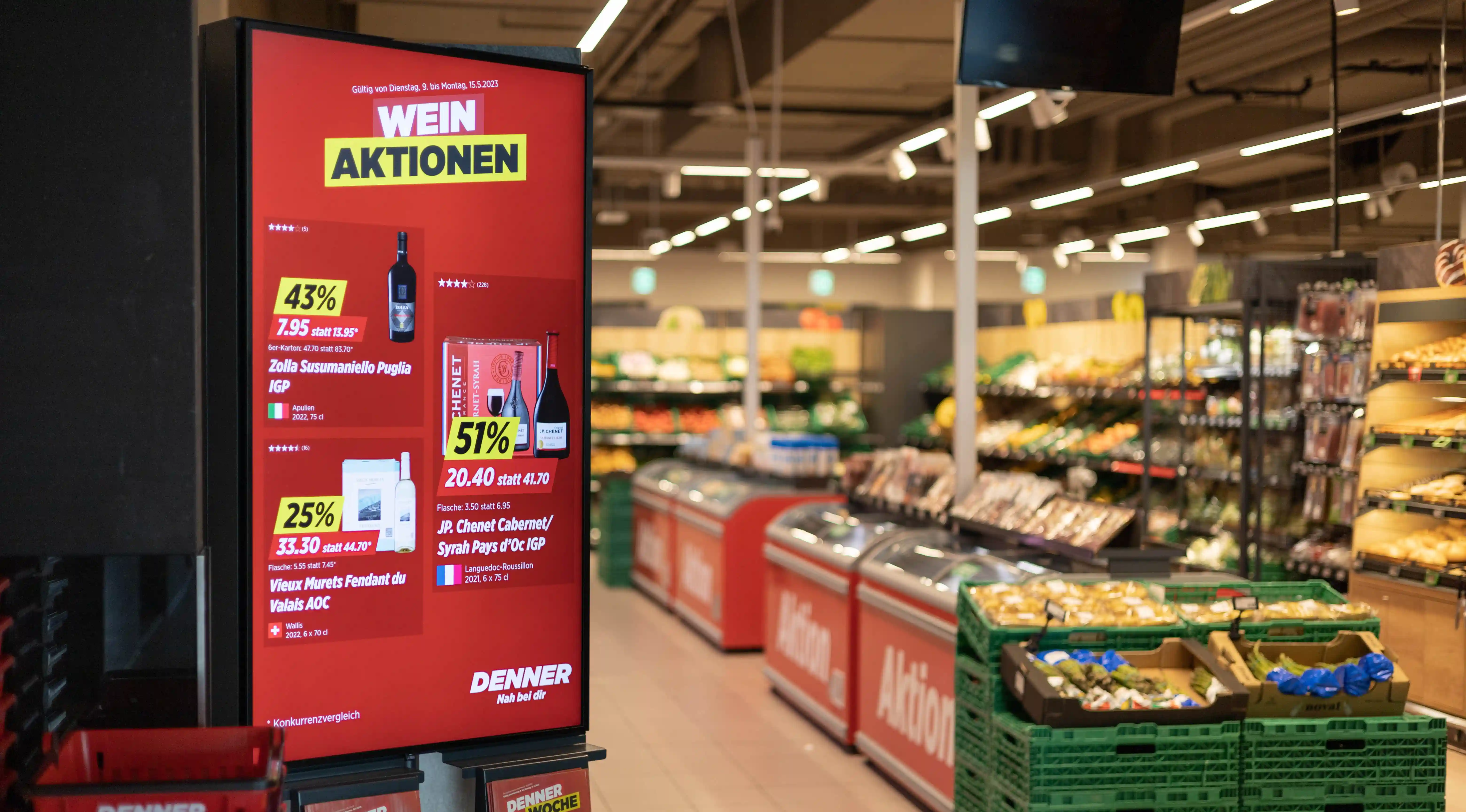
Denner Reference
What do I need to know about content automation at jls?
What does jls mean by content automation and automated content creation?
In the content automation offering, jls defines it as no longer maintaining content manually per channel, but creating and delivering it automatically using templates, rules and data sources. From product data, location information or campaign parameters, automated content is generated for digital signage, websites, portals or campaigns without your team having to build every single variant manually.
Automated content creation means that you define once how a content module is structured and content automation dynamically generates multiple versions from it, for example for different branches, languages, target groups or offer combinations.
What advantages does content automation bring for marketing and content teams?
With content automation, you reduce manual effort, lower error risks and gain speed. Changes to prices, assortments or messaging only need to be maintained in one place. The underlying logic ensures that all affected content is updated automatically. This becomes a major advantage when dealing with many locations, large digital signage networks or recurring campaigns.
At the same time, design stays consistent because all content is based on the same templates. Content teams can focus more on storytelling, messaging and campaign ideas while recurring variations are generated through automated content creation. In the content automation references you can see how this works in practice.
How does content automation differ from traditional content management?
In traditional content management, your team maintains content manually in a CMS or individual systems. Teaser texts, images, prices or variants are adjusted per page, channel or screen. This works well for a small number of assets but becomes time-consuming and error-prone once multiple locations, languages or frequently changing offers are involved.
With content automation, jls works with templates, rules and data sources. Instead of building each variant manually, you define structure and logic once and automated content creation generates the appropriate versions for, for example, digital signage, websites & self service portals or campaign placements. Your CMS or portal remains important as a distribution and control layer, but the content population itself is largely automated based on data.
Which use cases is content automation particularly suitable for?
Content automation is especially valuable when you need many similar pieces of content in different variations. Typical scenarios include retail with multiple locations, promotional communication on digital signage, regional or language-specific campaign versions, dynamic teaser areas on websites & self service portals or recurring communication patterns in industries such as finance or energy.
In the blog post on content automation and scalable content production, jls shows how you can move from initial pilots to a scalable setup and which use cases are particularly suitable for getting started.
How does content automation work technically at jls?
From a technical perspective, jls connects data sources, templates and distribution channels as part of content automation. Data can come from PIM, ERP, CRM or specialized systems and is inserted into design templates via defined rules. The resulting variants are then delivered to the relevant touchpoints, for example to digital signage, websites & self service portalsor campaign tools.
Within the technology area, jls ensures stable interfaces, correct data mapping and seamless interaction with existing systems. This creates a technical foundation that can be expanded step by step instead of requiring a full system overhaul at once.
How does content automation work together with digital signage, websites and mobile apps?
At jls, content automation is intentionally designed across channels. A single data set can simultaneously feed teaser areas on a website, cards in a customer portal, content in a mobile apps & pwa setup and spots on digital signage. Rules determine which variant appears where, for example based on location, time of day, product category or target group.
Combined with gamification, game states, leaderboards or personalized incentives can also be updated automatically without building each campaign individually. Examples of such setups can be found in the references.
How do I start a content automation project with jls?
If you want to start a project around content automation, you can first explore the content automation offering and the technology area and review relevant references. This helps you quickly identify whether you want to start with a single channel such as digital signage or connect multiple touchpoints from the beginning.
You can contact jls via the contact section without obligation, whether you already have defined data sources, an existing CMS or simply the goal of “more automated content” in mind. Together, you clarify which content is suitable for initial automation steps, how content automation should interact with customer experience and design and how to move from a pilot to a scalable setup. Further background can be found in the blog post on content automation and scalable content production.