Khoa Nguyen
Head of Architecture, Infrastructure & Operations
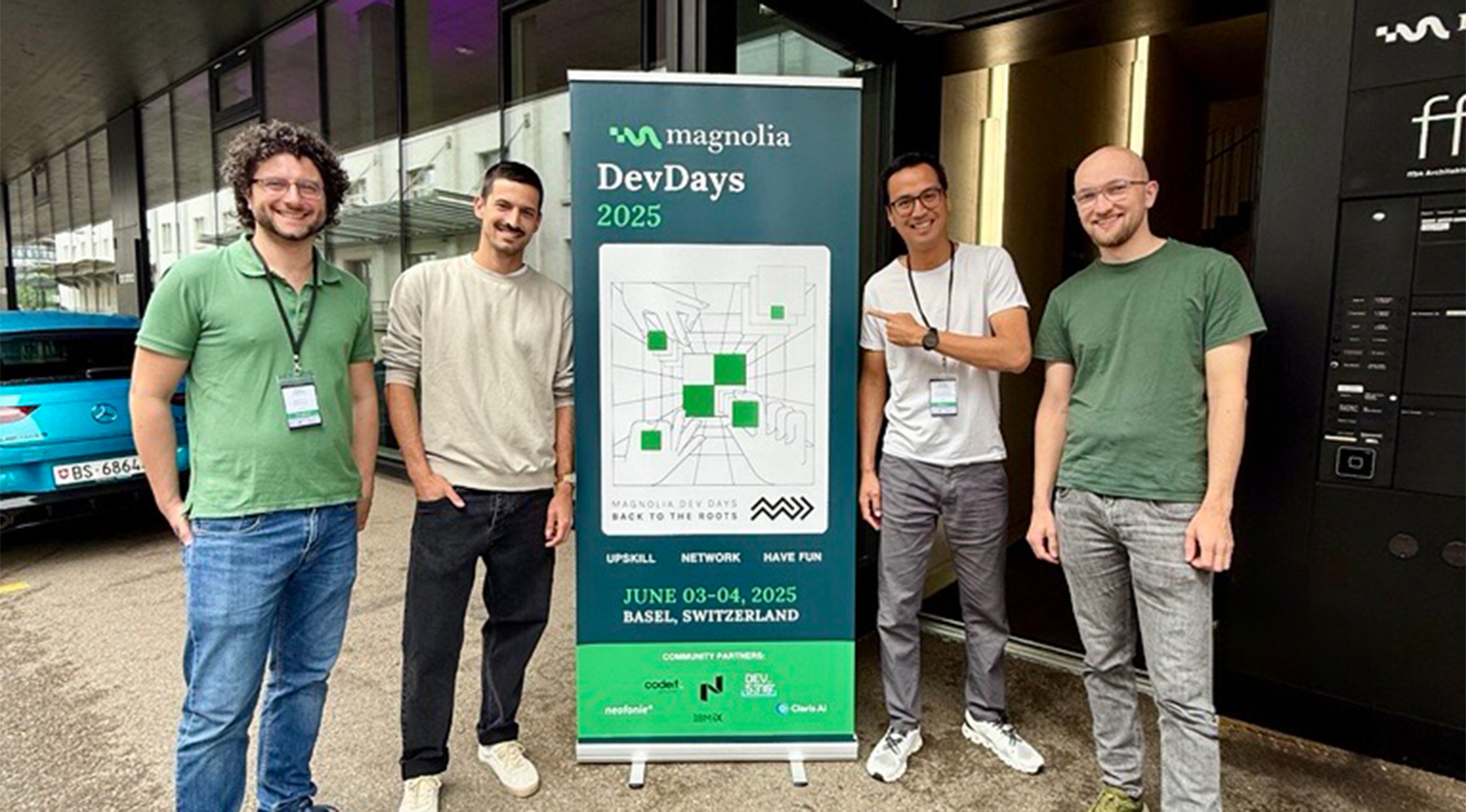
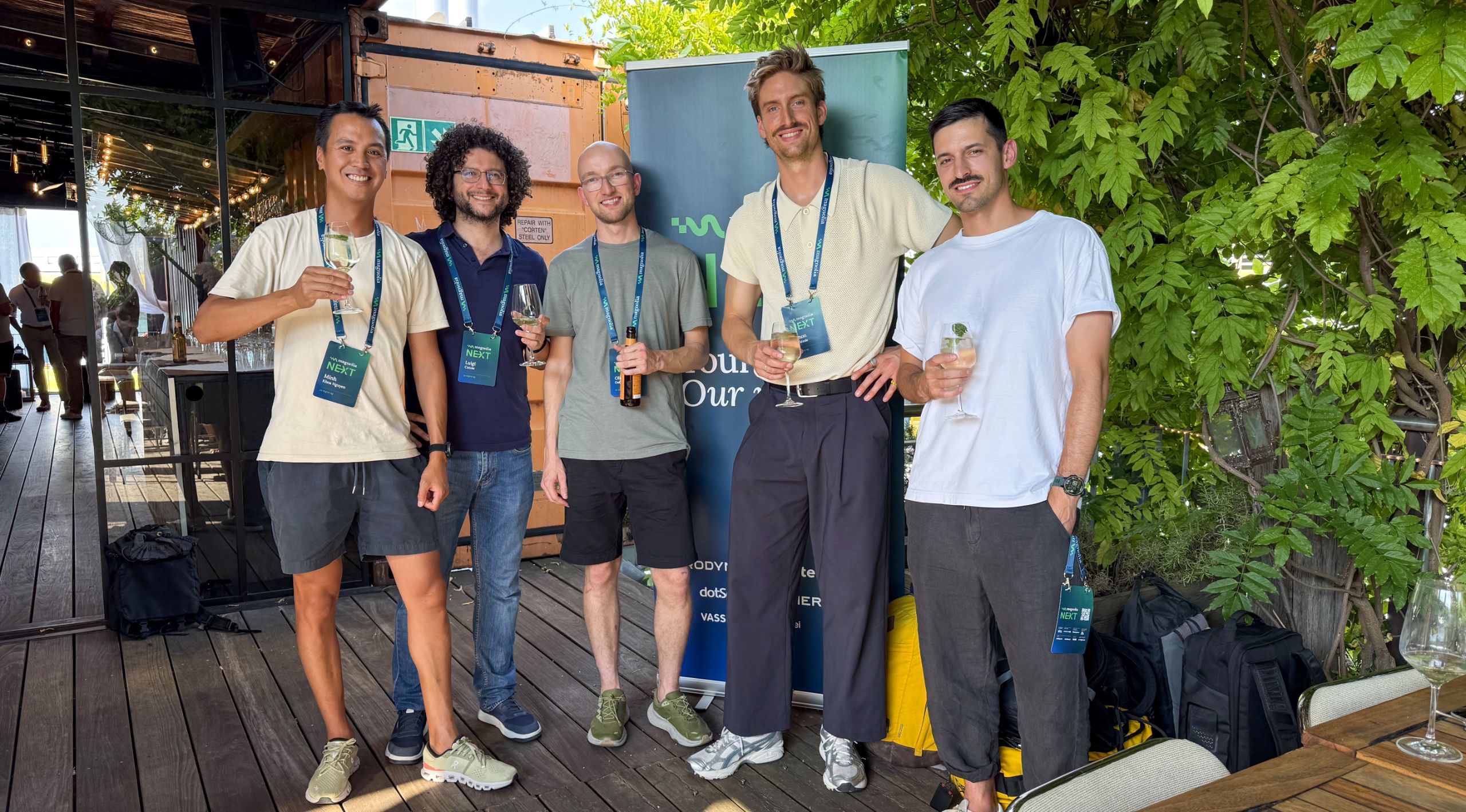
Last year I attended the Magnolia DevDays and wrote about AI integrations, the new AdminCentral and rendering strategies. This year I was back again, and beyond all the content, it is always a real pleasure to meet all the people in person that you usually only deal with digitally, and to exchange ideas. You come back every time with a head full of ideas and insights that then flow directly into the work on our client projects.
What follows are my personal takeaways from the talks I attended. As for the content, there were no really big surprises this year. A lot of what was presented I already knew from last year. With a platform like Magnolia, that is not unusual. To be honest, Magnolia is a large monolith with a corresponding legacy backpack that needs to be dismantled cleanly, while the product is being developed further at the same time. On top of that, work is happening in parallel across so many streams, all of them innovative: infrastructure, cloud services, author experience, storage layer and much more. That takes time, and you can tell. Still, there were things that genuinely interested me, and a preview of what is coming that leaves me curious.
6.4 is not the big thing (for us at least).
Magnolia is making a big announcement around 6.4 and that 6.4 is the future, with new features only appearing there from now on. That is a fair statement, and anyone still on 6.2 or 6.3 should really get moving, or get in touch with us. But let us be honest, we have known 6.4 since last year, and 6.4.0 was already released last year too. By now we are already on 6.4.7.
For our clients at jls, this is fortunately no drama. We have already migrated the majority to 6.4, a deliberate decision that is paying off now. We had already heard most of the "news" around 6.4 at last year's DevDays, so this year it was more of a repeat than an announcement.
AI: From Hyperprompts to the Agentic Era.
What occupies me most on this topic is not a single Magnolia feature, but the pace of AI development in general. What was still shown as a big highlight at conferences a year ago already feels almost outdated today. Filling a text field with AI, generating an SEO description, adjusting a writing style: that was exciting in 2025. Today it is simply standard, or even dated.
Magnolia has to go along with this shift, just like every other platform. And I have the impression that they are doing it right! Last year everything revolved around individual, isolated AI actions. This year Magnolia is talking about agentic AI: you define a more complex task, and the system works through it independently in several steps, without you having to trigger every intermediate step by hand.
On the question of which AI model is used for this, Magnolia is sticking with the proven BYOK principle: Bring Your Own Key, no lock-in to a particular provider. They even take the view that different models are better suited to different tasks. A different one for translations than for complex reasoning. That is pragmatic thinking and makes complete sense in practice.
The MCP Server.
For development, this was probably one of the more concrete and long-awaited points: Magnolia has its own MCP server and also provides curated AI skills. In concrete terms, this means an AI like Claude can interact directly with Magnolia through the MCP server. Thanks to the included skills, it knows how to build Magnolia projects according to best practice, the "Magnolia way", without you having to teach it that laboriously first. This saves time and reduces the errors that occur when AI tools simply guess how a framework works based on web research. Anyone who has experienced that knows what I am talking about.
The real highlight: The new Visual Editor.
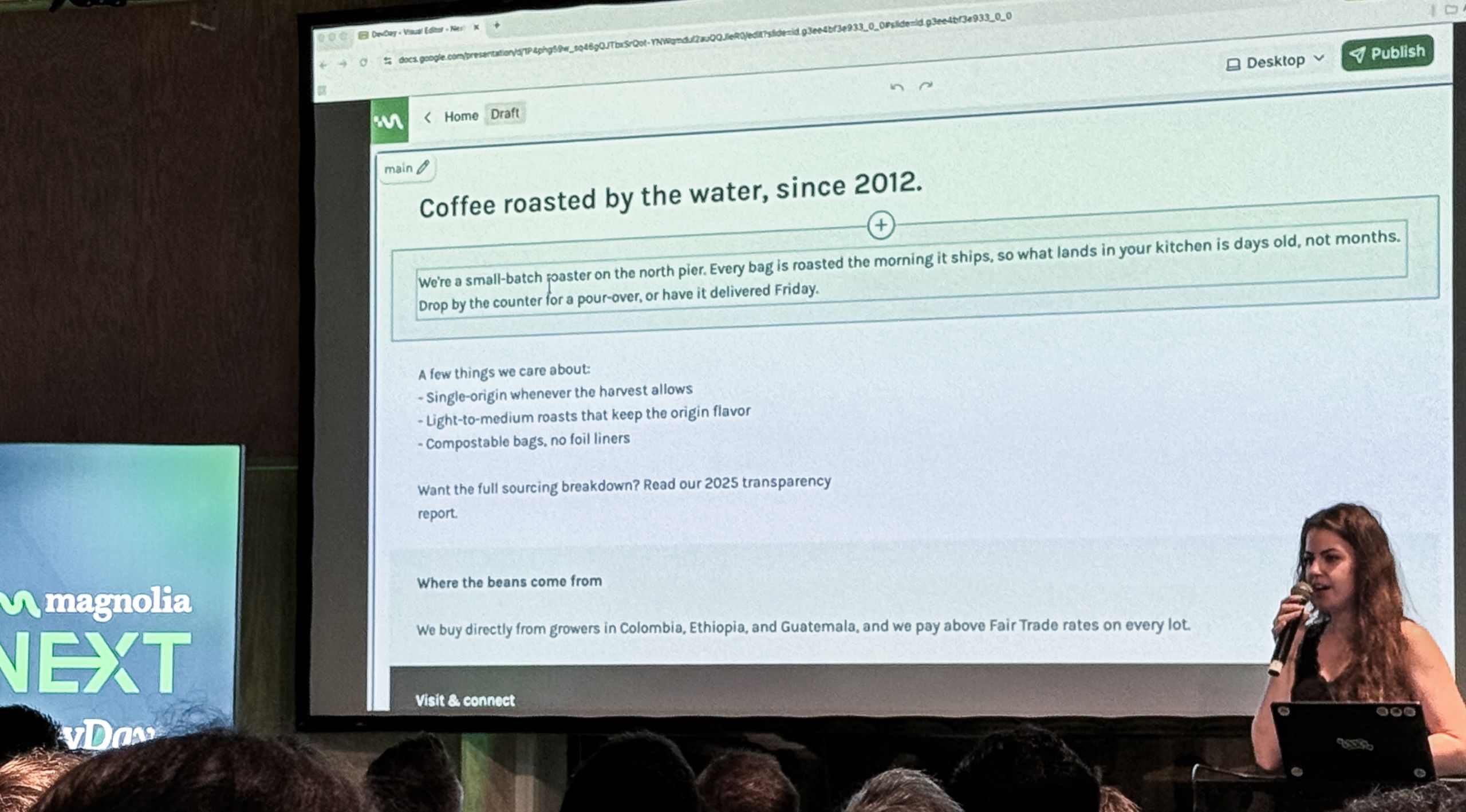
Now I come to the reason I started this post with "The best is yet to come". Magnolia showed a preview of the new page editor, and it really is a different calibre than the current page editor. No more popup dialog to edit content, no green bars, no interruption of the flow. You simply write directly on the page, inline, the way you would always have expected it and the way you know it from other platforms. On top of that there is undo and redo, locally, without saving. Collaborative work is also said to be possible, similar to what you know from FigJam. It is not available yet this year, but what I saw really convinced me. This will be the biggest UX leap for content authors in Magnolia in a long time.
AdminCentral in React.
Known since last year, but getting more concrete: AdminCentral is being rebuilt in React and is WCAG-compliant (accessibility). For developers this is good news, because custom views are much easier to implement than before. Magnolia also provides its own design system that you can reuse directly when building your own interfaces. For clients, this means more tailored backends in the future that fit more seamlessly into the Magnolia world, without us having to develop everything from scratch.
The future of the DX Cloud.
We know the Magnolia DX Cloud well: a powerful all-round offering with CDN, firewall, highly available infrastructure, monitoring and much more, all from a single source. For clients looking for a globally scaling, high-performance, redundant and secure platform without wanting to handle operations themselves, it remains a convincing offer.
What was missing so far was flexibility for situations where that is not possible. For regulatory reasons, some clients cannot use the DX Cloud offering in this form. Magnolia is now addressing this with a hybrid cloud model: the client can take over certain parts themselves, for example providing the infrastructure, while Magnolia contributes operations. In its most consistent form, Magnolia even runs the entire application, and the client focuses exclusively on content creation. I think this hits an important niche. We have come across such requirements several times already in tenders.
Behind this there are also substantial improvements at the infrastructure level that should make the entire platform more stable, simpler and faster. And this groundwork is probably also meant to bring back Magnolia SaaS as a serious market offering on the side. But to be honest, the Magnolia SaaS topic has been on the table for over three years now. Whether it really arrives this time and finds traction remains to be seen.
Vector Database.
Magnolia is announcing a vector database that enables semantic search. I hope this will one day mean the Magnolia search is good enough out of the box, without having to integrate external services like Elasticsearch or Solr. In projects this came up again and again, because the native search simply was not enough for more complex requirements. Whether this will be the solution remains to be seen, but the direction is right.

My personal verdict.
For me Magnolia NEXT 2026 was not a conference of big surprises, but one with a clear direction. AI is being integrated more deeply, the developer experience is improving step by step, and the new editor will fundamentally change the authoring experience once it is available. The open question remains whether Magnolia can actually deliver the many announced concepts in a reasonable time.
Oh, and one small thing on the side: staying focused on talks at 37 degrees outside was quite a challenge in itself. A big shout-out to all the presenters who handled it with composure regardless. And the jls team? It cooled off late in the evening with a jump into the Rhine. See you next year!
Interested in talking about Magnolia CMS?
Get in touch with Khoa:
FAQs
What is new in Magnolia 6.4?
6.4 is the future main version of Magnolia, and new features only appear there. At jls we have already migrated the majority of our client projects to 6.4, so for us it is no longer a new topic.
What can the new Magnolia Visual Editor do?
It allows inline editing directly on the page, without popups and without interrupting your workflow. On top of that come local undo and redo as well as planned collaborative editing. A preview was shown at NEXT 2026, but it is not available yet.
What does agentic AI mean at Magnolia?
Instead of individual, isolated AI actions, you define a more complex task and the system works through it independently in several steps. Which AI model is used is up to you, thanks to the BYOK principle.
What is an MCP server in the Magnolia context?
Through the MCP server, an AI like Claude can interact directly with Magnolia. Included skills ensure that projects are built according to best practice, without anyone having to teach the AI that laboriously.
Learn more about software solutions
Blog post «Swiss Software Festival 2026»
Blog post «UX Camp Europe 2026»