



Nevio Liberato
Software Development
Agentic AI: why verification is becoming the bottleneck.
At the Swiss Software Festival 2026, Agentic AI was the dominant topic. AI that does not merely respond, but acts autonomously. As a software developer, I attended a talk that put an uncomfortable truth into sharp focus: generating output is no longer the problem. Verifying it is. And it is precisely this bottleneck that determines how far we can truly trust AI agents in practice.
What makes Agentic AI distinct and why the system is what counts.
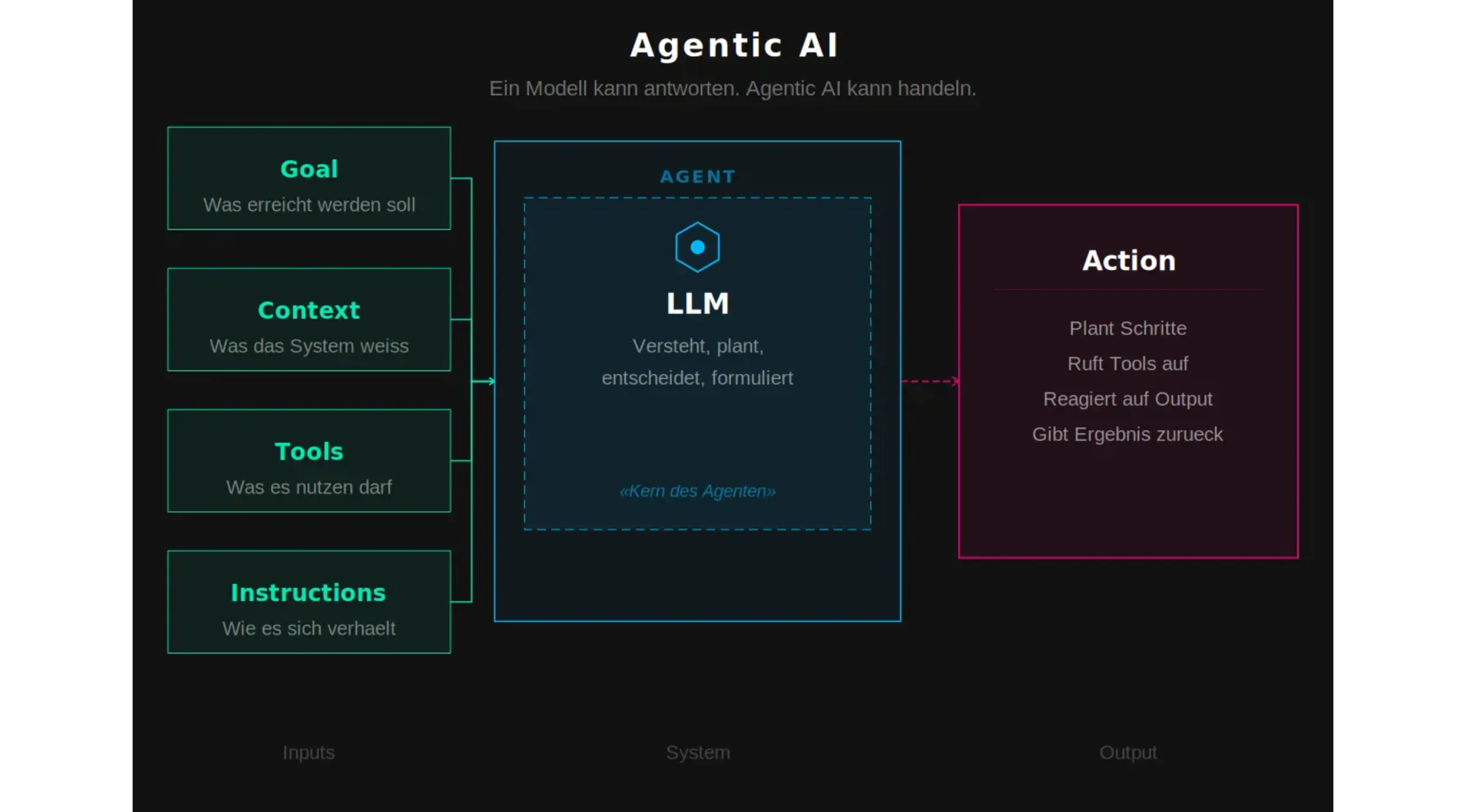
The speaker framed it well: a language model can answer, Agentic AI can act. Four building blocks make this possible: a Goal, Context, Tools, and Instructions. The model itself is just one component. A solution only becomes agentic through the system surrounding it, the system that orchestrates these parts. In practice, this means: anyone building Agentic AI invests less in the «biggest» model and more in clean context management, clearly defined tools and transparent rules. That's where it is decided whether an agent delivers reliably or drifts out of control.
The new bottleneck: verification, not generation.
The strongest moment of the talk, for me, was this thesis: AI can now generate more output than teams can responsibly review. Generation has scaled. Verification has not. The guiding question used to be «Can the model do this at all?» Today it is: «Can we verify and control what it has done?»
This mirrors my day-to-day as a developer: code, texts, and analyses are produced in seconds, but review, testing and sign-off remain human-paced. When ten agents are running in parallel, verification becomes the real bottleneck, the most important engineering discipline of the years ahead.
From agents to loops: what this means for organisations.
Today, a person starts the agent, reviews the result and issues the next instruction. They set the pace at every step. In future, the system itself will recognise that work needs doing, act, verify the result (!), update its state, and decide on the next step. Individual agents become loops. For organisations, this means: success won't go to those running the most agents, but to those who can show what their agents did and why they stopped. Agentic AI is not a better chatbot; it is controlled execution. Traceability, audit logs and clear termination criteria are therefore just as important as the model itself.
How we are approaching this at jls.
Agentic AI is not an abstract topic for the future at jls. We are actively engaged with it. Within our Solutions department, we have already run hands-on AI Build Workshops, where the team experimented, discussed and learned together. We also have a clear AI-first vision with guiding principles that give us a shared sense of direction for how we use and develop AI in our day-to-day work. This is complemented by dedicated knowledge-sharing formats designed to foster learning across teams and share concrete best practices.
Conclusion.
My takeaway from the Swiss Software Festival 2026: Agentic AI is here to stay. The key driver is not the next model, it is verification. Those who can review and control what their agents do will come out ahead. That is exactly where the investment is worthwhile.