
Larissa Renggli
Interaction Design
AI generates layouts, writes text and delivers dozens of interface variations in seconds. Nevertheless, good design today is no less human than it was ten years ago, it is just a different kind of human. What matters is not what AI can take over, but where it genuinely makes sense and where humans remain simply irreplaceable.
At jls, we are taking a close look at this shift and asking ourselves the practical question: How is AI changing the work of Interaction Design, and what aspects of it remain fundamentally human?
What AI can really do in Design.
AI is no longer just a buzzword; it is a productive tool, if you know how to use it. According to HubSpot Labs (2025), 77% of agencies that use AI in the design process report that the time required has decreased by 36%. In design, there are clear areas where AI measurably speeds up processes:
- Iteration and Exploration: What used to mean three variations now means thirty. AI makes it possible to quickly test different directions and visually explore ideas without investing a disproportionate amount of time. However, the creative decision which variant is the right one and why remains with the designer.
- Research and Analysis: Competitive analyses, heuristic reviews, mood boards, trend research: Anything that can be structured and does not require deep interpretation can now be partially automated. This creates space for what really matters.
- Documentation and Handoffs: Repetitive tasks such as specifications or handoff descriptions for development which used to be very time-consuming can now be handled by AI or at least prepared by it.
- Text Drafts and Content: Initial versions of interface texts, error messages, or onboarding flows are produced more quickly. Fine-tuning in terms of tone, brand voice and nuances in expression remains the designer’s responsibility.
What all these areas have in common is that AI handles the predictable tasks. As soon as context, judgment, or human understanding are required, the picture changes fundamentally.
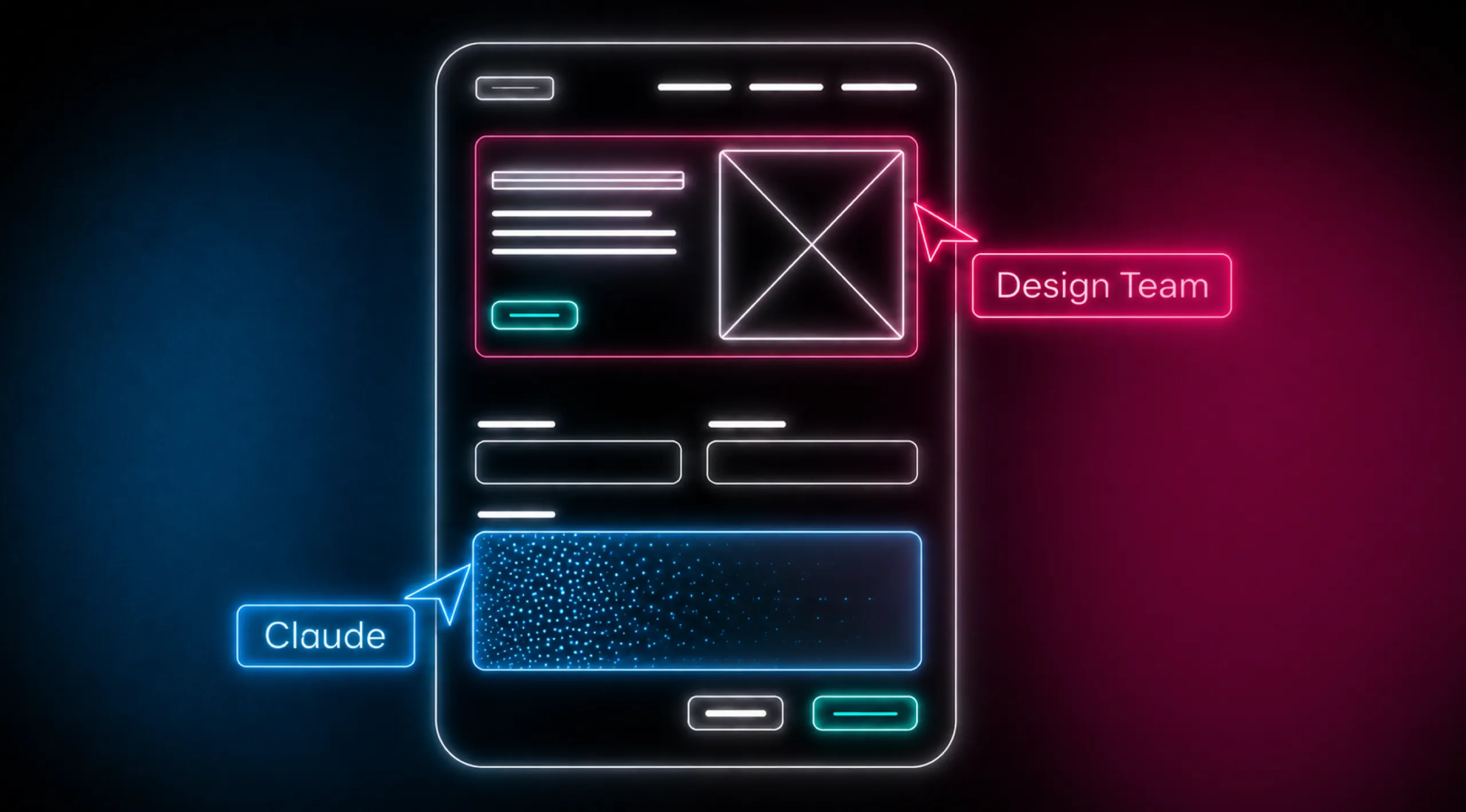
Where humans remain irreplaceable.
Good design emerges from the interplay between people, not between algorithms. Even the most powerful AI cannot change that.
Empathy cannot be automated
Conducting a conversation with a user, reading the subtle cues when someone says, «Actually, it’s already working», even though their body language suggests otherwise, that is human perception. AI analyzes raw transcripts. It does not understand what lies between the lines.
Contextual understanding and responsibility go hand in hand
Good design emerges from the interplay between user expectations, business goals, and technical reality. Whoever makes these trade-offs must also be able to take responsibility for them. That remains a human task.
Creative vision requires a stance
A design that truly conveys a message comes from a specific perspective. It reflects values, priorities, and viewpoints. AI optimizes for what’s most likely, not for what is right.
Trust cannot be delegated
Convincing stakeholders, breaking down resistance and developing a shared understanding require social and communicative skills that cannot be delegated.
The real tension: quality vs. efficiency.
AI speeds up design processes. That sounds good, but it also carries a risk.
When work can be done faster, the pressure to do more of it increases. But more output does not necessarily mean better design. Depth takes time: User tests need to be analyzed. Concepts need to be reviewed. Good solutions require critical thinking.
The key point: AI-driven efficiency is only a real benefit if the time saved is invested in design depth. In genuine user research, in conceptual thinking and in critical evaluation. If, instead, that time is simply used to produce more output, you are just churning out mediocrity faster.

Which Design skills will become more important in the AI era.
The question is not whether AI is changing design processes, but: which human skills will matter even more as a result?
- Critical judgment is becoming more important. Those who pass on AI output without reflection produce mediocrity at a rapid pace. Those who evaluate, curate, and purposefully improve it are stronger than ever before.
- System thinking is gaining importance. Understanding how a design fits into the bigger picture - technically, organizationally, and in terms of usage - is a skill that AI cannot replicate.
- Co-creation and communication are becoming more central. The designer as a silent producer is becoming a rarity. The designer as a conversation partner, facilitator and strategic sparring partner is becoming more valuable.
- Prompt engineering is a design skill. Those who use AI tools effectively need clarity about what they want and the ability to articulate it precisely. This is design thinking in a different form.
What this means in practice.
AI is changing how we do design work. It does not change why we do it. The core of good design - understanding, empathy, judgment, and responsibility - remains human.
What is changing is the expectation: Designers must become better at what AI cannot do. This means targeted investments in genuine user research, strategic conceptualization, and strong communication skills.
AI is a powerful tool, not a replacement for judgment. And what we need, now more than ever, is a clear understanding of what good design truly means.
FAQs.
How exactly is AI changing designers’ day-to-day work?
Everything is happening much faster: That sounds like a relief, but it’s also a challenge. Designers need to get better at what AI can’t do. Critical judgment, systems thinking, co-creation, and prompt engineering are becoming increasingly important.
How can AI be efficiently integrated into work processes?
There are clear areas where AI measurably accelerates processes: iteration and exploration, research and analysis, documentation and handoffs, as well as text drafts and content creation. However, good design emerges from the interplay between people—and that won’t change in the future.
What risks does the use of AI in the design process pose?
A tension arises between quality and efficiency. AI can generate larger volumes of output. However, the decision as to whether the quality of this output is sufficient must be made by humans. Good solutions require critical thinking.
Interested in an exchange on the topic of «Interaction Design with AI»?
Contact Larissa:
Interested in an exchange on the topic of «Interaction Design with AI»?
Contact Larissa:
Learn more about Design at jls.

Reference «Betty Bossi.»
Blog post: «Content creation has been democratized. Good judgment has not.»