Sienna Gabriel
Mediamatikerin in Ausbildung
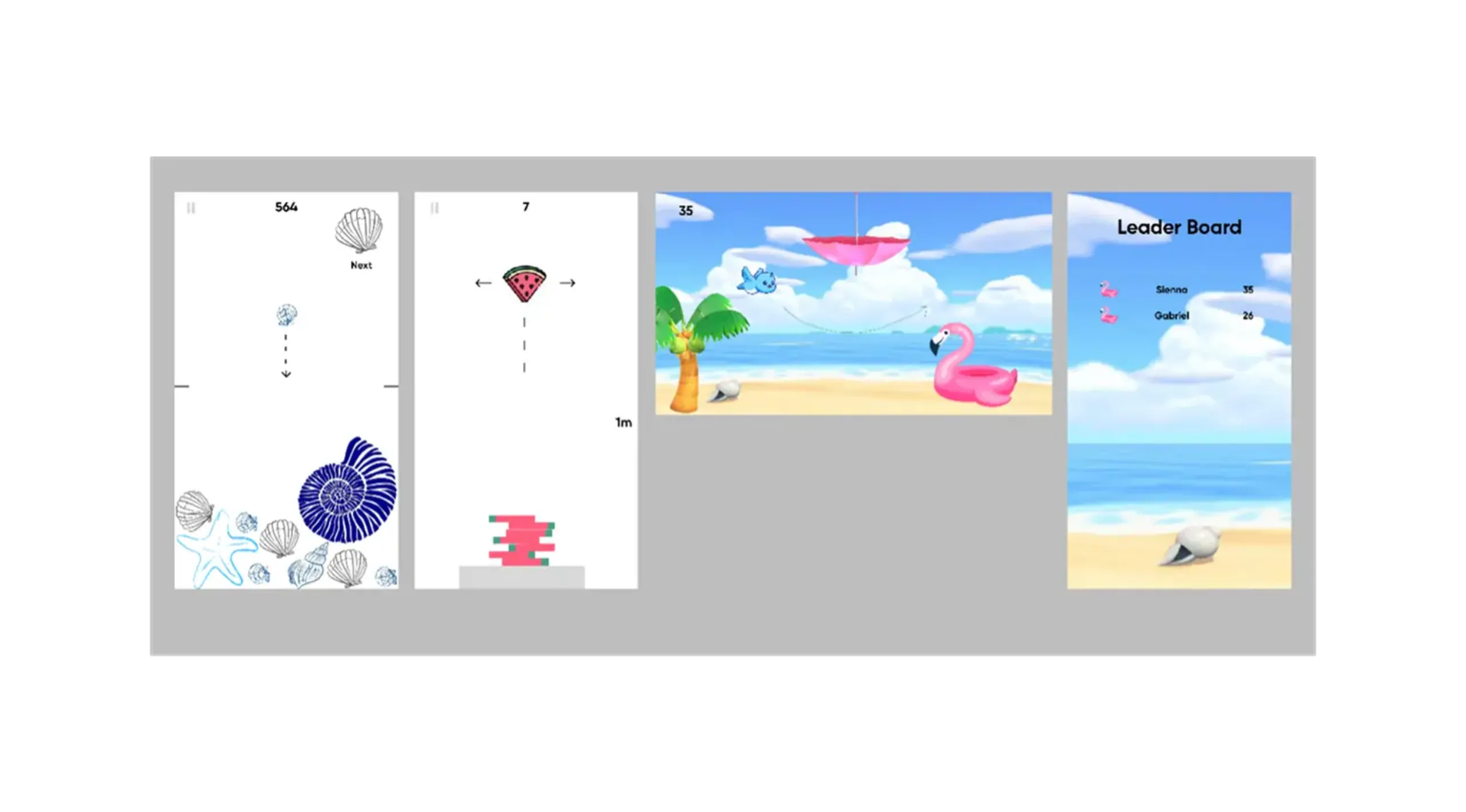
Pipsi, a blue bird, has lost his flock, and my task was to help him find them again. For the jls Summer Game 2026, as a media technology apprentice, I had the opportunity to design and program my very first game: “The Call of the Feathers.” At the beginning, I thought about what kind of game it should be. I drew inspiration from Pinterest and my initial research and came up with several concepts: from a merge game with seashells to a melon-stacking game, all the way to a summer-themed version of Flappy Bird.
In the end, I decided to go with the Flappy Bird concept. It’s easy to understand, still fun to play, and fit well with the summer theme. Plus, I had enough creative freedom to incorporate my own ideas, like the collectibles.
From Idea to Design.
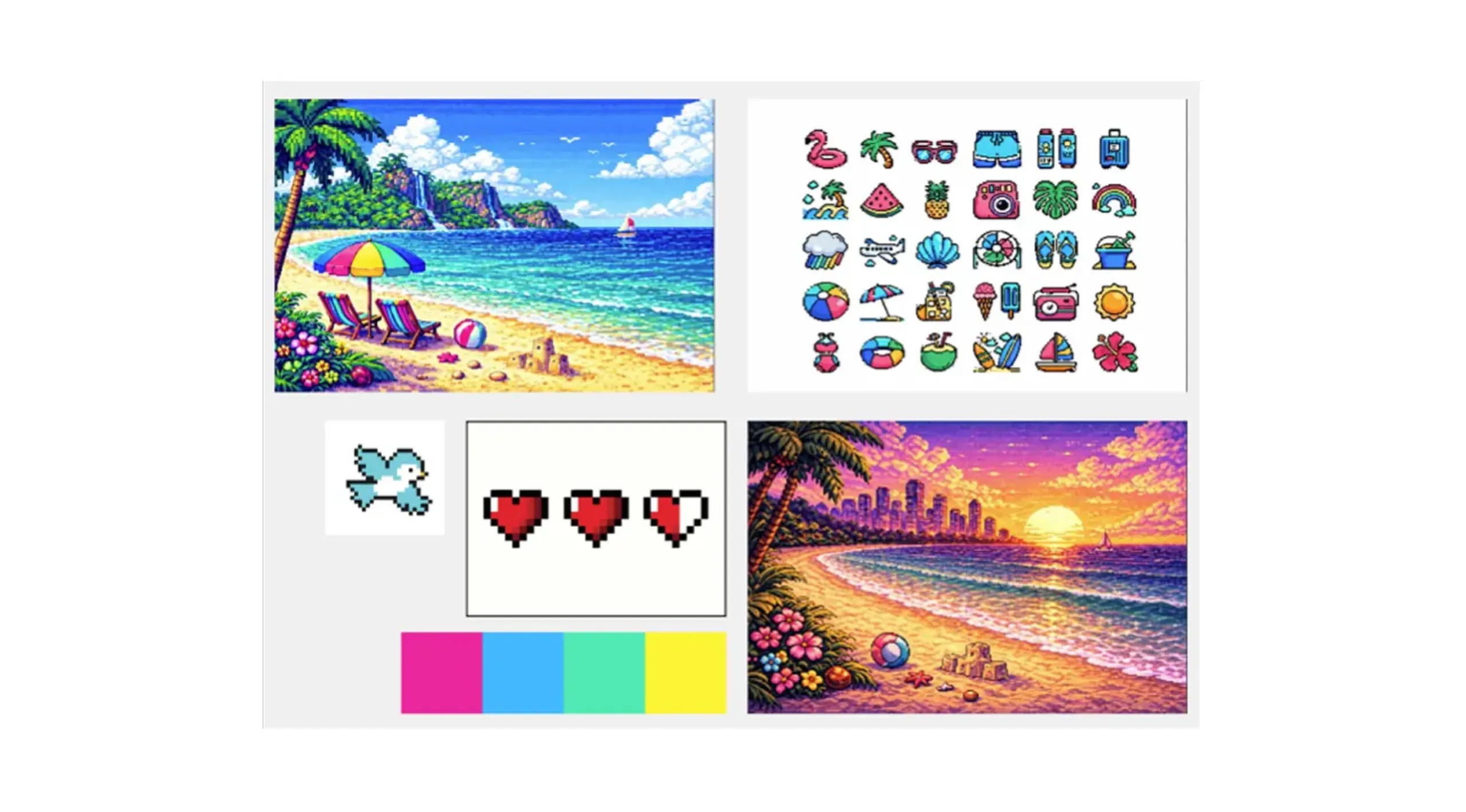
For the visual style, I opted for a pixel art style set in a summery setting, featuring sunsets in pixel worlds and similar motifs. I compiled a color palette, pixel icons, and sample images on a mood board so that I had a clear idea of the mood, colors, and elements before I began the actual design.
When working with Figma, the biggest challenge was understanding components and Auto Layout. At first, I didn’t see why I needed them when I could do everything manually. In the end, though, I was glad I did: as soon as I adjusted the main component, all the others were automatically adjusted as well. That simplified things enormously, and over time I became more and more confident using Auto Layout.
Storytelling and characters bring the game to life.
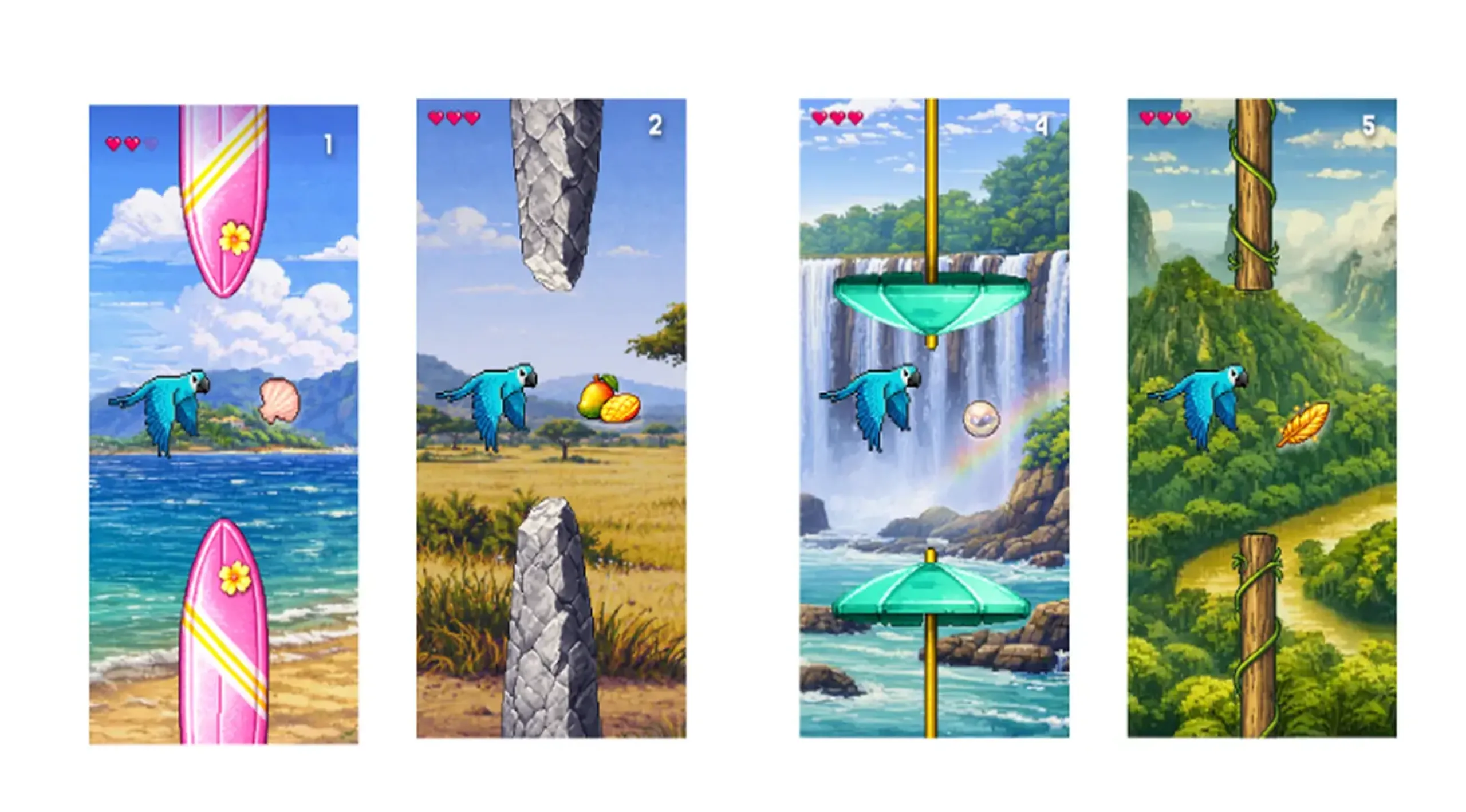
A game isn’t just about mechanics and the interface. It’s the storytelling and the characters that make it exciting. At the center of it all is Pipsi, a blue bird who has lost his flock. No one knows exactly where the other birds have gone. But Pipsi keeps finding little clues that lead him, step by step, closer to his flock.
And so begins his journey across different worlds. It starts on the beach, where Pipsi gathers his first clues amid the summer atmosphere and the sea: seashells. Then the trail leads him to the savanna, which seems more vast, drier, and wilder, and where he collects mangoes. Next, he reaches the Iguazú Falls, one of the most spectacular stops, amid roaring waterfalls, rocks, and rainbows, where pearls await him. Finally, the trail leads deep into the Amazon: fog, vines, and dense jungle make this world the wildest stop of all. Here, Pipsi is closest to his flock, which is why the most important bonus item awaits him here: the golden feather, which represents the decisive clue.
When designing the game, it was important to me that each world have its own distinct character while still maintaining a sense of a cohesive journey. This way, each stage feels fresh, while Pipsi guides players through all the worlds as a familiar companion.
User Experience and Gamification.
The focus was on the user experience. The goal was to create a playful and motivating experience for all participants. Players accompany Pipsi on a fast-paced flight, guide him through the worlds, dodge obstacles, and collect bonus items.
Gamification was particularly important: Every item collected—whether a seashell, mango, pearl, or golden feather—earns points for the team and helps Pipsi continue following the trail of his crush. Pipsi isn’t immediately out of the game if something goes wrong. He has three hearts and loses one each time he collides with an obstacle. Only when all three are used up does the run end. This keeps the game fair and gives every team a chance to recover after a mistake.
If Pipsi completes the entire route, the journey starts over, because the search isn’t over yet. Over the course of two weeks, all runs count toward the team ranking. In the end, the team that best guides Pipsi through his journey and collects the most points wins.
Reflection: My First Game Project.
To be honest, at first I was a little daunted by what lay ahead, because programming isn’t really my strong suit and I was unsure about the entire project process. As the project progressed, however, I realized that I was understanding more and more with each step. Thanks to the Jira tickets and the support from my teammates and Claude Code, I was able to work through the tasks one by one. The more I understood, the more fun I found programming to be.
I learned a lot, especially in the area of UX design and working with Figma. I realized how much small details—like the three-heart system or the feedback when collecting items—influence the user experience. Even though programming might not be my greatest strength, I learned a great deal from this project and am proud of the final result.
FAQs.
What is gamification?
Gamification involves incorporating game-like elements such as points, levels, leaderboards, or rewards into a context that is not inherently game-like. The goal is to increase motivation and engagement. In The Call of the Feathers, for example, the point system, bonus items, and team rankings keep players engaged.
What is Figma, and what is it used for?
Figma is a browser-based design tool for UI and UX design. It allows you to design user interfaces, build prototypes, and customize them efficiently using features like Components and Auto-Layout. For my game, I created the entire design in Figma, from the screens down to the individual elements.
What is the Mediamatik training program like at jls?
The training program at jls is very hands-on. Instead of just learning theory, you take on your own projects right from the start and grow through real-world tasks. You’ll work across design, development, marketing, and media, supported by experienced colleagues. The jls Summer Game is a good example of this: a project that you oversee yourself from the initial idea to the finished product.
Learn more about gamification and training at jls.
Blog Post: «Training to Become an ICT Specialist at jls.»

Blog Post: «Mediamatik Training at jls.»