23.06.2026
Author: Peter Reitmann
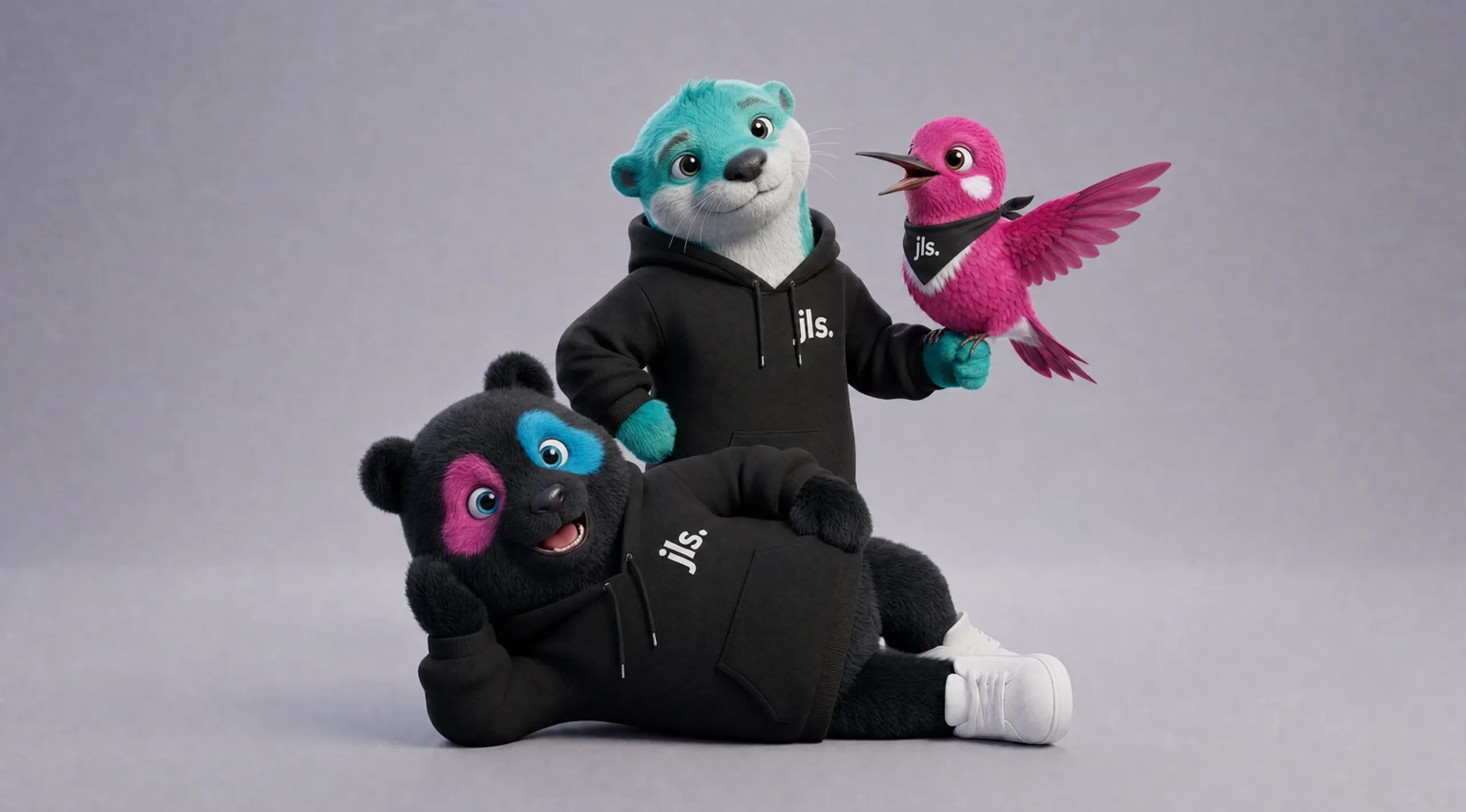
Anyone who creates images with AI doesn’t struggle with the creation itself—but with evaluating them. I learned this from an after-work experiment that got out of hand: a panda in a jls hoodie, black instead of white, with eye patches in our brand colors.
The test turned into a wallpaper on my MacBook, and before I knew it, coworkers wanted one too—customized just for them, of course. Suddenly, the question arose: Does jls actually need a mascot?
The idea came about completely by chance—without a workshop, without a strategy deck, and without a single meeting. AI makes ideas visible before you’ve even decided whether you want them at all. This is currently shifting the design process dramatically. But the more effortless production becomes, the more crucial it is to judge whether the result is right—down to the last detail. Because that’s something AI can’t do yet.
AI Character Design: What a Panda Teaches Us About Prompting and Consistency.
The Problem with the Inverted Panda
The jls panda isn’t a normal panda. That sounds trivial, but it isn’t when you’re working with AI. A typical panda is white with black eye patches. The jls panda is the opposite: black, with colored eye patches in our brand colors. That’s exactly what threw the image models off.
No matter how precise the prompts were, white pandas kept popping up. Out of nowhere. The image model’s trained world view: panda = white with black spots. For us, the deviation was intentional; for the model, it was an anomaly it tried to correct. The fault lies not with the prompt, but with a fundamental principle: AI excels at what it knows, and as soon as something falls outside the statistical norm, you’re working against the model instead of with it.
The result: Even when simply replicating an existing character, you always need fresh reference material and very precise descriptions. A prompt that worked once isn’t enough. Each new generation is a new context, and without an anchor, the model reverts to the average.
Can an AI character system be applied to new characters?
Once the panda was working internally, we expanded the crew: an otter and a hummingbird were added. The logical assumption would be to take the existing system and apply it.
It’s not enough to just copy and paste or use a clever prompt—each character requires its own work. A hummingbird is not a panda. Proportions, physique, distinctive features—everything is different. What serves as a reference for the panda is based on a specific visual that doesn’t exist for the hummingbird. You have to do the same groundwork all over again: define reference material, describe the character precisely, understand its unique traits, and explicitly name them. And all the while, you have to keep the system in mind so that all three characters ultimately feel coherent.
Anyone who thinks a well-functioning character system can be applied to a new character with minimal effort will be disappointed by the results. The approach remains the same: don’t start from scratch, but build upon what’s there. But building still means investing work.
Content looks good quickly. That’s the real problem
This is where the biggest misunderstanding lies when dealing with AI-generated assets. AI images quickly look professional. The composition, the lighting, the character seems consistent. If you don’t look closely, you see a finished image. What you don’t see: the eye color has changed. A small detail, almost invisible at first glance but it’s wrong.
It happened to us, too. The characters’ eye color was a clearly defining feature, and yet it sometimes changed unnoticed during the generation process. We didn’t always catch it on the first pass ourselves. The problem isn’t with the model, but with us: The image looks so polished that we don’t even bother to scrutinize it. What happens when you start mass-producing an asset that contains an error? The error multiplies. Ten wallpapers with the wrong eye color. Fifty variations with a detail that’s off. And the larger the system, the harder it is to correct.
But that’s not an argument against scaling—it’s an argument for taking a closer look beforehand. More than ever before.
From Image to Video Generation with AI.
Why Is It Harder to Maintain Consistency in an AI Video?
What applies to images also applies to video—multiplied by the factor of time. AI-generated videos can appear convincing in a matter of seconds. Movement, camera work, atmosphere—these elements come together quickly. What doesn’t come quickly, however, is consistency. A character who has the correct eye color in frame 1 may suddenly look different in frame 60. A movement that starts off well sometimes ends up with incorrect anatomy. A background detail changes between two scenes without anyone having instructed it to do so.
This is still the rule—not the exception—even with better models. Anyone who generates videos with AI and then watches them only once will miss errors. Anyone who generates and scales videos without first checking whether the character is consistent is exporting inconsistency. This applies to wallpapers just as much as to animated campaigns, teasers, and social media content. Anywhere a character is supposed to be recognizable.
How reliable is GPT Image 2 when it comes to prompts?
The cube gets smaller, but it remains a cube. Anyone who works with image models knows the fundamental tension: You describe something precisely and get something back that deviates slightly from it, sometimes significantly. That’s just how generative models work.
With GPT Image 2, this has improved significantly. The model follows prompts with a precision that wasn’t possible before. Nevertheless, there are still glitches. A concrete example: A dollar sign suddenly appeared in a background element.
The model itself decides what isn’t explicitly stated. This requires a different kind of discipline: not just saying what you want, but also saying what you don’t want. And then checking to see if the model has made any implicit decisions. Good prompt structures and reference material help. But “one-shotting”—getting a final, usable image on the first try—remains the exception.
The Mix: The Best of Both Worlds.
Is AI Making Creatives Obsolete?
Content creation has been democratized—that’s true. Anyone who today needs hours to produce a solid initial image has a problem other than a lack of time. But judgment hasn’t been democratized. That’s the crucial difference.
The ability to recognize which details are wrong. That the currency is wrong. That the character looks “too normal” this time because the model has once again defaulted to the trained average. That a movement in the video is anatomically incorrect. These observations require that you know the character, understand the craft, and know where to look. The more content that is generated, the more valuable the people who can assess quality become.
This isn’t a contradiction to democratization—rather, it’s its logical consequence: When anyone can create content, the focus shifts from production to evaluation. The role is changing: away from pure production, toward curation, quality assurance, and system responsibility. You can only spot the wrong detail if you know what the right one looks like.
The system: Reusability as a fundamental principle
Set it up right once, then scale it. Don’t start from scratch every time. For the workflows, we worked with weavy.ai, also known as Figma Weave. The tool allows you to visually build, save, and share node-based AI image workflows with others. Anyone who has built a working flow for panda generation can share it directly. No copy-pasting prompts, no “write down your setup for me”: the system itself is the document. This becomes crucial as soon as multiple people are working on a character system. Consistency doesn’t come from a good memory, but from reproducible processes.
From testing to a physical figure
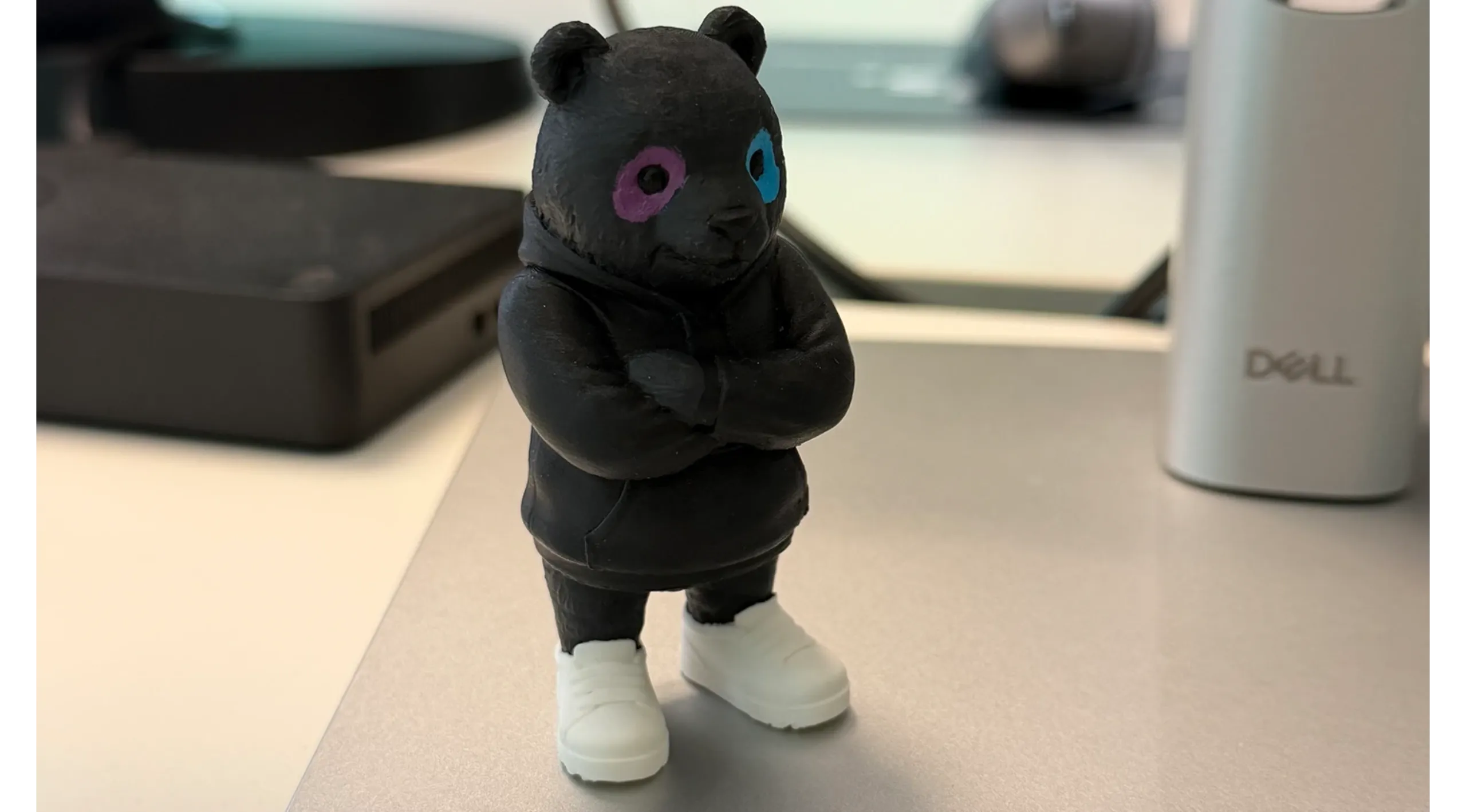
What really rounds out the whole story for me is the momentum and development it gained on its own. From a test to a 3D-printed version that now sits on my desk. A colleague 3D-printed the panda for me. A spontaneous after-work test turned into a physical figure. Simply because we gave it a try. For me, this marks the culmination of a development I never planned this way.
What tests or ideas have you already discarded because they seemed too time-consuming? There’s never been a better time to just give something a try. The barrier to entry has never been lower.
What we're taking with us.
The Panda has evolved from a personal experiment into a full-fledged internal project—not through planning, but organically. There’s a fundamental principle behind this: AI lowers the barrier to bringing an idea to life. But the following points must be taken into account:
- AI isn’t a simple tool that you can just set up and let run; it’s a system that requires attention.
- AI is not a substitute for quality, but rather a production accelerator. Quality control still rests with humans.
- There is no one-size-fits-all workflow: systematic content creation must be carefully and individually structured.
- Don’t lose sight of the details in the rush to move fast. We need to look closely—more closely than ever before.
FAQs.
What AI tools did you use for the Panda?
For image generation, we primarily used GPT Image 2 and Nano Banana 2/Pro; for animated content, we used various video models (mostly Seedance 2.0). For workflow automation, we used weavy.ai (Figma Weave), which allows us to visually build node-based image workflows and share them directly with the team.
Why is a good prompt often no longer enough the next time around?
Every generation is a new context. AI models have no memory between generations - without fresh reference material, the model reverts to the trained average. To the model, a panda is white with black spots. Any deviations from this must be explicitly anchored each time.
How much work does it take to build your own character system?
More than you might think at first, but significantly less than it used to be. The biggest effort isn’t in the generation itself, but in the setup: defining reference material, describing the character precisely, and documenting its unique traits. Once you do that properly, scaling up becomes much faster.
Do I need prior design experience to achieve results like these?
What matters most is a trained eye and the ability to look closely. You need to be able to spot errors that the model has inadvertently introduced and know what the correct result should look like.
Interested in an exchange on the topic of «AI Systematic Content»?
Contact Peter:

Learn more about AI Systematic Content

Offer «Content Automation.»
Blog post «Content Automation: Automate and scale content production.»